


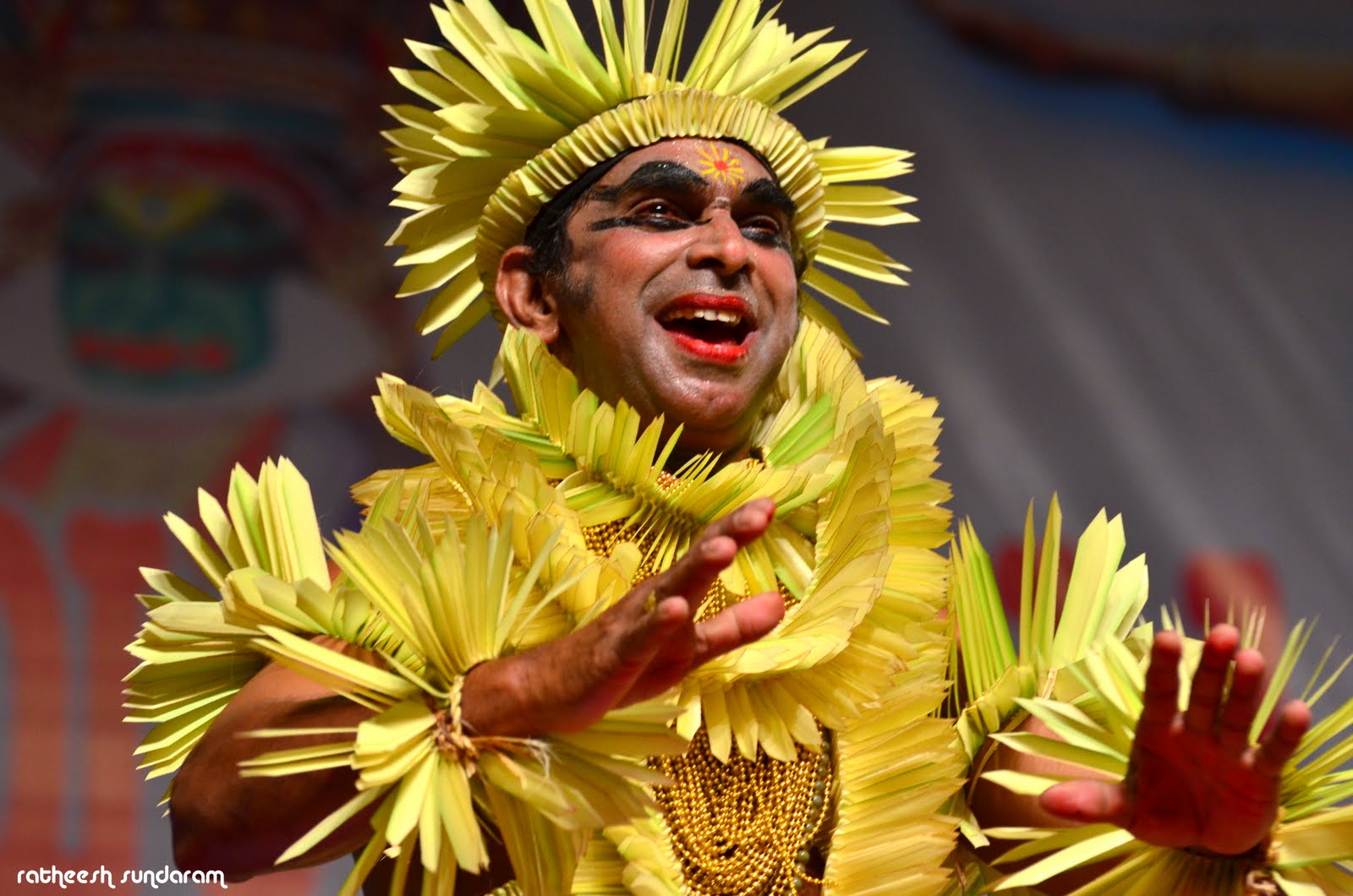


Seethankan Thullal is a traditional dance ofKerala. It uses metres of medium cadence. Unlike many other performing art forms, the dancer in Seethankan Thullal does not paint his or her face. A few black lines on the eyebrows and eyelids are used to intensify the expression of the eyes. A crown made of tender leaves of coconut palm is worn by the dancer.Maddalamand cymbals are the musical instruments used.
Caste ridden and laden with the evils of discrimination and oppression, Kerala society was in dire need of a messiah who could bring men back to their senses. Even fine arts had become the forte of the rich and the learned; the elite Brahmins spoke a Malayalam heavily spiked with Sanskrit and this influenced the music of the dance forms such as Kathakali. This dialect was beyond the understanding of the lower classes that started to feel culturally deprived. At this time, about 200 years ago, emerged Kunjan Nambiyar. An artist par excellence, Nambiyar was extremely well versed in dance, music and poetry. He brought the fine arts into the lives common masses. Art, Nambiyar believed should bring entertainment to the spectator, immaterial of his caste, religion or social status. Also it is the artist's cardinal duty to highlight the social evils and malpractices society indulges in. Only through the mass appeal of art can the injustices and inequalities aced by some be addressed. His thinking and expert skills made way for the new art form Nambiyar propounded, Thullal. Rich in music, rhyme, rhythm ad meter, Thullal is also replete with satirical wit and humor. Nambiyar combined a semi classical dance form with social sarcasm and criticism. But he did use his iron fist within a velvet glove. His humor was explosive and those he targeted, often ended up laughing at themselves. Nambiyar's themes were taken from the ever popular epics, but Nambiyar added his own charm and made these legendary characters more mundane. They were prone to the biases of society and therein he created space for his own brand of ruthless humor. Nambiyar was undiplomatic and relentless in his jest. He could forgive the more ordinary vices of human nature but was quite intolerant of egotism and guile some men showed. He exposed the innermost weakness of the "crafty" and showed that they were as prone to trickery and dogma as the rest. Nambiyar was an extremely knowledgeable musician and his musical plays composed for Thullal show proficiency in classic music ragas and beats (taala). Carnatic ragas such as Bilaahari, Shankaraabharanam, Kaambhoji, Naattakurunji, Mohanam, Aanandabhairavi, Punnagavaraali, and Indolam are used. Often a raagamalika or taalamlika (medley of ragas or taalas) is found in a play. This is used with dramatic effect to heighten the thrill of the scene. Nambiyar weaves together religious mythology and the desires and aspirations of men thereby transporting the spectators o a different world altogether. The language is straightforward Malayalam, the simple diction of the common man. Various classical dace forms and folk have been combined to create an experience enjoyable to the masses. The music is rich in beats and the dancer is accompanied by 2 percussionists- a cymbalist and a maddalam player. The cymbalist repeats the Thullakaran's (dancer's) lines for a dramatic effect.
The Thullal starts with an invocation sung by the cymbalist and the Thullakaran praying salutations to God and his orchestra. The solo artist then does a jig in front of his orchestra (i.e. with his back to the audience). Then he turns and the play starts. The dancer now sings a line and when it is repeated by his percussionist he dances to the tune Extensive use of body postures, hand gestures and facial expressions are used by the dancer to express the meaning of the verses. The performer takes up the role of detached narrator and yet gives an impassioned performance to the same lyrics the very next instant. The dance performance is spangled with pieces of vigorous footwork.
The 3 varieties of Thullal are as follows:Ottan Thullal: Ottan Thullal is well loved and perhaps is regarded with the most favor among the masses. The music is high in tempo and the dance fast. The attire or costume of the dancer includes a knee length white and red skirt worn around the waist, a chest plate decked essentially with a number of metal and glass beads. The other ornaments are also pretty gaudy and decorate with tinsels, glass etc. Like in case of Kathakali the face is painted green and the lips and eyes are highlighted to bring out a spectacular effect. Head gear (such as crown or serpent head) is also worn and is striking. Bells are tied to the calf above the knee to provide a jingle every time the foot is struck with force.
Seethankan Thullal: In the Seethankan Thullal the rhythm and the tempo is not as fast paced as the Ottan Thullal and more emphasis is laid in the body movements and gestures as means of expression. In this form of Thullal the skirt is similar to Otta Thullal but the artist wears a head gear and armlets made of the leaves of tender coconut. Virtually no face make up is applied except for the highlighted eyes.
Paraya Thullal: In this Thullal the skirt worn around the waist is red in color and the make up is very basic. The headgear is elaborate though. The pace and tempo of this Thullal is the slowest making space for graceful body movements and elaborate gestures and expressions.
Though there is no strict rule, but generally Parayan Thullal is performed in the forenoon, Seethankan in the late afternoon, and Ottan after sundown. All three types of Thullal are not performed together. Last year a leading artist Mr. Prabhakaran and his children performed all 3 types of Thullal together on the same stage. The word Thullal in Malayalam mean a “prance like movement” also used to signify dance. Other kinds of Thullal such as Thumbi Thullal and Kolam Thullal are performed in Kerala during Onam and the temple festivals. But these are dainty folk dances performed by women to celebrate and are not dance or music rich as the Thullal founded by Nambiyar.
Though there is no strict rule, but generally Parayan Thullal is performed in the forenoon, Seethankan in the late afternoon, and Ottan after sundown. All three types of Thullal are not performed together. Last year a leading artist Mr. Prabhakaran and his children performed all 3 types of Thullal together on the same stage. The word Thullal in Malayalam mean a “prance like movement” also used to signify dance. Other kinds of Thullal such as Thumbi Thullal and Kolam Thullal are performed in Kerala during Onam and the temple festivals. But these are dainty folk dances performed by women to celebrate and are not dance or music rich as the Thullal founded by Nambiyar.
Performer C .Balakrishan a Senior Faculty in Gurugopinath Dance Academy Trivandrum .National Dance Fest Nisagandhi Trivandrum Kerala India


